
IXEAN Lawin Solar
THE PROBLEM
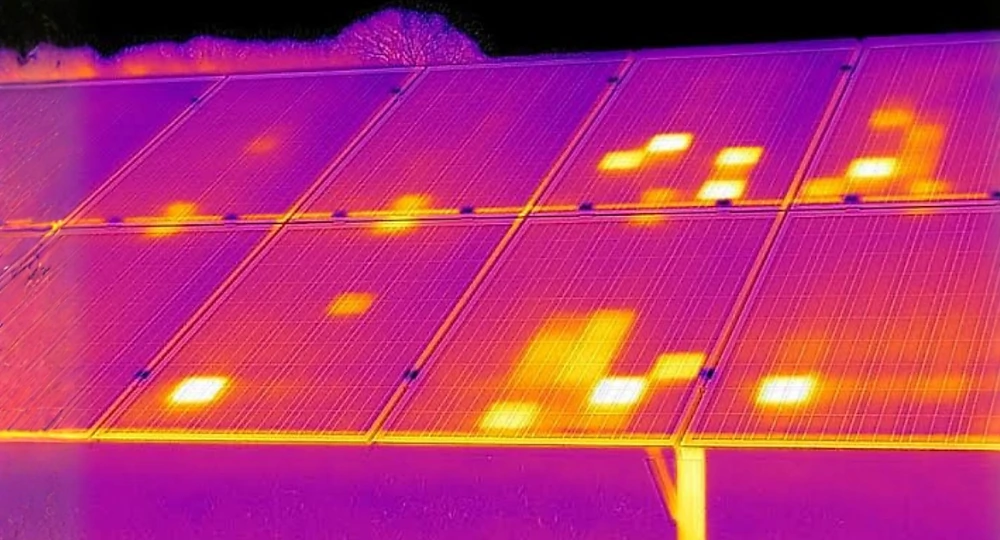
Photovoltaic (PV) systems operate in harsh, dynamic environments that significantly threaten long-term energy yields. While superficial issues like dust, debris, and avian waste, particularly in dry environments, can reduce output by 20% or more, the greater risk lies in degradation that cannot immediately be detected even with a trained professional. Micro-cracks, failing bypass diodes, and compromised junction boxes often appear healthy to the naked eye while silently disabling up to 30% of a panel’s capacity.
Left unchecked, these marginal damages aggregate across thousands of panels, creating a systemic performance deficit that is impossible to isolate using traditional methods. By the time this degradation manifests as a noticeable drop in total power output, the window for preemptive maintenance has closed, necessitating costly, large-scale component replacement. In regions like the Central Luzon basin, where infrastructure faces the dual challenge of extreme dust accumulation followed by sudden, high-volume typhoon rains, this degradation is a critical threat to grid stability.
To ensure the profitability of massive solar investments, which require 80–85% sustained performance over a 20-year lifecycle, rigorous, preemptive diagnostics are mandatory. Current manual and single-drone inspection methods fail to scale, creating a "data bottleneck" that prevents rapid, actionable oversight.
To effectively manage world-class facilities like SPNEC and TSPI, we require more than just a camera in the sky; we require a force multiplier.
The IXEAN Lawin Solar is our modular flagship solution engineered specifically for this use case. The Lawin is a fully autonomous, medium-sized quadcopter designed to operate within a coordinated swarm for rapid area assessment. Furthermore, Lawin Solar can also be used to patrol large solar farms to prevent trespassing.
Operational Workflow
- Autonomous Swarm Coordination: A fleet of N Lawin Solar drones divides the solar farm into mission-optimized subregions. Each unit executes a pre-programmed, grid-based flight path, ensuring 100% coverage with zero manual pilot intervention.
- Edge-Native Intelligence: Utilizing high-resolution RGB and thermal sensors, each Lawin Solar processes imagery through an onboard AI module. This allows for real-time damage detection, classification, and output-impact estimation at the point of capture. While our primary recommendation utilizes our Edge-Native AI (IXEAN Mata) for mission-critical, low-latency performance, we offer an optional Cloud-Hybrid mode.
- Unified Command Interface (GUI): A single operator manages the entire swarm through our intuitive GUI, featuring live telemetry, GPS-tracked flight paths, point-and-click mission re-tasking, and individual drone diagnostics.
Lawin Solar is designed for mission agility, offering three distinct modes:
1. Fully Autonomous: Grid-search diagnostics for high-efficiency, wide-area coverage.
2. Semi-Autonomous: Point-and-hover command for targeted inspection of specific anomalies.
3. Manual FPV: A low-latency override mode, allowing an operator to conduct high-precision manual inspection when human intervention is required.
The IXEAN Advantage
Unlike standard drone providers who treat AI as an "add-on," Lawin Solar is powered by Mata and Diwa for its damage detection and autonomous pathing. We provide an ecosystem that is fundamentally designed for scalability—enabling one operator to manage a swarm, rather than one operator per unit. By deploying Lawin Solar, operators can catch minor, preventable degradation before it evolves into a systemic grid failure, ensuring that massive solar assets maintain their peak profitability for the duration of their 20-year lifecycle.